Why I started Plant Care How To
I was twenty-five, knee-deep in compost and frustration, when I realized I’d been doing gardening all wrong.
My basil had bolted before its first real harvest, my tomato plants kept wilting at the most critical moment, and my neighbor’s marigolds—planted from the same packet—were thriving while mine looked like they’d been abandoned.
I asked her for advice, and she just laughed, handed me a trowel, and said, *‘You’re not killing them. You’re just not listening.’* That stung. But it stuck.
So I started keeping notes. Not just what I planted, but the temperature that day, the soil pH, the exact time I watered, and what happened next—whether the leaves curled or the roots grew.
I wanted a place where those details didn’t get lost in vague advice like *‘water when the soil is dry’* or *‘give it sunlight.’* This site is for the people who’ve felt that same frustration: the ones who want to know *why* a plant thrives or dies, not just *how* to fix it after the fact.
Meet the founder

My mom still has the photo: me at ten years old, standing in our backyard with a watering can the size of my forearm, declaring that my ‘jungle’ was a *science project.* She was wrong—I was just terrible at pruning.
That same overgrowth habit followed me into adulthood, but this time, the plants were the ones suffering. I’d buy a fiddle-leaf fig, follow the care instructions to the letter, and still watch its leaves yellow within weeks. The problem wasn’t my green thumb; it was the missing pieces.
No one told me about the draft near the window, or how the tap water in my building had a pH that made the soil toxic.
The turning point came with my first attempt at growing peppers from seed. I swore I’d done my research: warm soil, consistent moisture, bright light. But the seedlings kept collapsing at the stem.
It wasn’t until my aunt—a retired horticulturist—squatted beside me and pointed out the *real* issue: I’d planted them too deep. ‘Seeds don’t like to be buried alive,’ she said, and I’ll never forget the way she tapped the soil with her knuckles to show me what *right* felt like.
That’s when I started taking notes like my life depended on it.
Now, my desk is a graveyard of failed experiments. There’s the shelf where my first attempt at hydroponics turned into a moldy science project, the notebook where I tracked the exact moment my pothos leaves started drooping (spoiler: it wasn’t underwatering).
And then there’s the one plant I’ve never killed—a stubborn snake plant that’s outlived three apartments. It’s ugly, lopsided, and I still don’t know why it refuses to die. Maybe that’s the point.
If you’re wondering why I write about gardening like it’s a detective story, blame the habit of muttering to my plants while I troubleshoot. My partner says it’s weird. The plants don’t seem to mind.
Meet the mascot
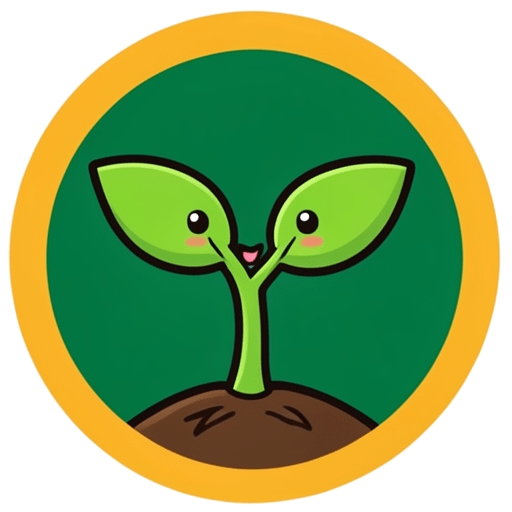
The mascot started as a scribble on a napkin during a lunch break at the city park. I was watching a bee land on a lavender stem, and the way its legs bent to steady itself got stuck in my head.
I drew it first as a quick sketch—a blob with too many legs, all tangled around a seedling that looked like a question mark. My neighbor, who’d seen me struggling with my tomato plants all summer, laughed and said, *‘That’s not a bee. That’s your gardening anxiety.’* Fair.
The next version was proper ink on paper: a bee with three legs (because six felt too much like work) and a seedling that actually looked like a sprout. I added the little soil clods around its feet to make it look like it was digging in, not just hovering.
The problem was, it still looked too busy. So I simplified—lost the clods, made the legs thinner, and gave the seedling a sharper point. Now it’s just a bee and a push, like the first moment a seed remembers the sky.
We call it *Poke*. Not because it’s poking the seed (though it does look like it), but because it’s the sound a seed makes when it’s ready to break through.
You’ll see it on every page where things get tricky—wilting leaves, fungal spots, or that moment when you’re not sure if your plant is dying or just sulking. It’s supposed to feel like a nudge, not a lecture.
What I promise you
This site exists because gardening advice is often as vague as the weather report: *‘Give it sunlight’* (how much?), *‘water when dry’* (how dry?).
Here, you’ll find the specifics I wish I’d known earlier—like the fact that most houseplants need *less* water in winter, or that marigolds actually *hate* being transplanted after they’ve sprouted. I promise to call out the gaps in the advice, even when it’s my own.
What you can hold me to
- Every plant profile includes the *exact* conditions I grew it in—light levels, soil mix, and what went wrong when I broke the rules.
- Troubleshooting guides start with symptoms, not solutions. If your leaves are yellow, I’ll tell you whether it’s overwatering, underwatering, or a nutrient deficiency—*and how to tell the difference.*
- I’ll admit when I don’t know. If a method is debated (like whether to pinch back basil), I’ll say so—and point you to the studies or my own experiments.
- The site updates when new research comes out. That ‘old wives’ tale’ about burying tomato plants? I tested it. (Spoiler: it works, but not for the reason you think.)
How I create a guide
A guide starts with a failure. Not the kind you’d brag about—like the time I killed a $20 orchid in a week—but the quiet, stubborn ones. The fern that kept browning at the edges no matter how much I misted it.
The pepper plant that refused to fruit until I moved it *away* from the south-facing window.
I jot these down in a notebook with three columns: *What I tried*, *What happened*, and *What I’d do differently.* The first draft of any guide is just that notebook, with photos of the before and after.
The first step: watching for the wrong things
The hardest part isn’t fixing a plant—it’s noticing when something’s off. Most beginners wait until the leaves are crispy or the stems are mushy before they act. By then, it’s often too late.
Instead, I train myself to check for *three* things every time I water or prune: the *color* of new growth (yellow? That’s a red flag), the *texture* of the leaves (sticky? Pests), and the *smell* of the soil (sour? Overwatered).
A healthy plant doesn’t just *look* fine—it *feels* right when you run your fingers over the stems.
Take basil, for example. If you’re growing it indoors, you’ll notice the leaves start to curl *before* they yellow. That’s your cue to check the humidity—basil hates dry air. I learned this the hard way when my first potted plant turned into a sad, crispy mess in three weeks.
Now, I keep a tray of water under it and watch for the curl. If it’s early in the day and the air feels thick, I’ll mist it. If it’s late afternoon and the leaves are still stiff, I’ll move it to a brighter spot. No guesswork.
The second step: the fix that’s not obvious
Once you’ve spotted the problem, the real work starts. Take black spots on tomato leaves—every guide says it’s fungus, so you spray copper soap. But if your tomatoes are in a pot on a balcony, the spots might actually be from *splashed water* or *too much nitrogen*.
I test this by isolating one plant: I stop fertilizing it, move it to a drier spot, and wait. If the spots stop within a week, the issue was environmental. If not? Then it’s time for the fungicide.
The trick is to fix *one thing at a time*. I see gardeners panic and do everything at once—more water, less sun, a new fertilizer—only to realize later that the real issue was a draft near the window. That’s why I document every change, even the small ones.
If I move a plant, I note the new spot. If I adjust the watering schedule, I mark the date. This way, if something goes wrong, I can backtrack like a detective.
How a guide gets onto this site
A guide isn’t done until it’s been tested *twice*—once in my apartment (where the light is crappy and the drafts are worse) and once in my neighbor’s greenhouse (where the humidity is through the roof).
The first draft lives in a shared doc where my partner—who has exactly zero interest in plants—has to say it makes sense. If she gets stuck on a step, I rewrite it.
If she rolls her eyes at a term like *‘hardening off,’* I replace it with *‘preparing seedlings for the outdoors like a tough-love parent.’*
The final version gets a second edit after it’s been live for a month.
If I notice a pattern—like everyone’s struggling with the same issue—I’ll add a troubleshooting section. No guide is set in stone. If you’ve got a better method for reviving a root-bound plant, I want to know.
Write to me
I love hearing about the plants you’ve saved—or the ones that got away. Send me photos of your weirdest gardening wins (that time your zucchini grew into a vine that took over the porch? I need details).
Tell me about the advice that worked when mine failed, or the myths you’ve busted in your own garden.
And if you’ve got a plant that’s been giving you trouble, describe it like you’re telling a friend: *‘It’s a spider plant, but the leaves keep turning brown at the tips, even though I’m watering it less and it’s not near a heater.’* That’s the kind of detail that turns a guess into a solution.
You can reach me through the contact page. No gardening question is too small, and no plant is too strange. If you’re curious about something you’ve read here—or just want to swap stories about the time your tomato plant outproduced you—I’m listening.
The guides are grouped by category: Advice, Companion Plants, Container Gardens, How To, Landscaping and Orchid Care.